14 July 2025
Ken F. Miller
This study guide is to be used with my book Understanding the Doctrine of Christ, according to Hebrews 5:12-14 & Hebrews 6:1-20. This guide has been laid out to be used in a classroom environment, using a very good Bible Concordance for scriptural references and either a KJV or NKJV Bible. It can be very easily used with my book which would explain in detail what is brought out here.
This blog is the most critical writing that you will ever read (except for the Bible) in your life because Salvation is a prerequisite to Perfection. Without perfection there is no Salvation and visa-versa.
Biblical Foundation for Salvation
Introduction
Let’s look at it from this perspective: we have a lock on a door and behind this door is Jesus knocking (Rev. 3:20-21) offering us eternal life with Him if we would just unlock the lock and open the door to let Him into our life (Note: He has even given us the ‘instruction book” (Bible) of how we can do this). Yes, there is a catch to this we must use the correct key or combination of numbers to open the lock. Also note, ONLY Jesus has the correct combination or key not mankind, which is included in the Bible. (John 14:6 (KJV) 6 Jesus saith unto him, I am the way, the truth, and the life: no man cometh unto the Father, but by me.
Understanding Salvation
To grasp the biblical foundation for salvation, it is crucial to understand what salvation means according to the Bible. Salvation refers to being rescued from sin, spiritual death, and eternal separation from God. It is both a present reality for the believer and a future hope. The Scriptures teach that all people are born into sin (Romans 3:23) and in need of redemption. Salvation is God’s way of restoring sinful humanity to a right relationship with Himself.
The Origin of Salvation: God’s Initiative
The foundation for salvation begins with God, not humanity. Salvation is granted solely by God’s grace and is not earned by human effort or religious activity
15 And he said unto them, Go ye into all the world, and preach the gospel to every creature.
16 He that believeth and is baptized shall be saved; but he that believeth not shall be damned. Mark 16:15-16
This reveals that God planned salvation even before the creation of the world, choosing to grant mercy and salvation to those He wills. Titus 3:5 further emphasizes: “He saved us, not because of righteous things we had done, but because of His mercy.” These verses affirm that the foundation for salvation is divine grace, not human achievement
Jesus Christ: The Central Figure of Salvation What Is Salvation According to the Bible?
To understand the Biblical foundation for salvation, we must first grasp what salvation means. In the Bible, salvation refers to being saved from sin, spiritual death, and eternal separation from God. It is both the present reality and the future hope. That everyone is born into sin (Romans 3:23) and in need of redeeming is taught by the Scriptures. Salvation is God’s plan for bringing sinful humanity back into a proper relationship with Himself. He is the author and executor of it; therefore, mankind has no authority to change it just to fit their denominational beliefs.
The Origin of Salvation: God’s Initiative
The Biblical foundation for salvation begins with of course God, not man. Salvation can only be earned by God’s grace and if He wills to grant it, it can’t be earned by just some habitual changes or a little reading of His word. In Ephesians 2:8–9, Paul writes, “For by grace you have been saved through faith, and that not of yourselves; it is the gift of God, not of works, lest anyone should boast.” This clearly states that God had planned on this even before the world began, he had decided to grant salvation and mercy to a few chosen ones
Titus 3:5 further clarifies this truth: “He saved us, not because of righteous things we had done, but because of His mercy.” These verses underscore that the Biblical foundation for salvation is not human performance but divine grace.
Jesus Christ: The Central Figure of Salvation
The centerpiece of the Biblical foundation for salvation is Jesus Christ. John 14:6 records Jesus’ words: “I am the way, the truth, and the life. No one comes to the Father except through Me.” Salvation is found in no one else, for there is no other name under heaven given to mankind by which we must be saved (Acts 4:12).
Christ’s death on the cross paid the penalty for our sins. Isaiah 53:5 prophetically declared, “But He was pierced for our transgressions, He was crushed for our iniquities; the punishment that brought us peace was on Him, and by His wounds we are healed.” His resurrection proved His victory over sin and death and assures us of eternal life.
Faith and Repentance: The Response to God’s Gift
The Biblical foundation for salvation also involves a very necessary response from us, faith and repentance. These are not just a few things we perform but these are God’s words to us that we need to instill in our lives. Mark 1:15 records Jesus’ first message: “Repent and believe in the gospel.”
Faith involves trusting completely in the finished work of Christ for our salvation. Hebrews 11:6 tells us that without faith, it is impossible to please God. Repentance, on the other hand, means turning away from sin and turning toward God in obedience. Acts 2:38 commands, “Repent and be baptized, every one of you, in the name of Jesus Christ for the forgiveness of your sins.”
Together, faith and repentance mark the beginning of the Christian journey and anchor the Biblical foundation for salvation.
The Role of the Word of God
Another key aspect of the Biblical foundation for salvation is the role of Scripture itself. Romans 10:17 says, “So then faith comes by hearing, and hearing by the word of God.” God’s Word reveals the truth about who we are, who God is, and how we can be saved. The Bible is not just a religious book, it is the word of God, and a complete guidance on how to live our lives and keep ourselves aligned with it.
The Work of the Holy Spirit
The Biblical foundation for salvation is incomplete without acknowledging the work of the Holy Spirit. It is the Spirit who convicts us of sin (John 16:8), regenerates our hearts (Titus 3:5), and seals us for the day of redemption (Ephesians 1:13–14). Without the Holy Spirit’s work, we would not be able to understand or respond to the gospel. He enables us to cry out to God in faith and gives us assurance of our adoption as children of God (Romans 8:15–16).
The Evidence of Salvation
Salvation is not only a moment in time; it is a transformation that bears fruit. The Biblical foundation for salvation includes a life that reflects the character of Christ. 2 Corinthians 5:17 states, “Therefore, if anyone is in Christ, he is a new creation; old things have passed away; behold, all things have become new.”
While works do not save us, they are the evidence of a changed heart. A person who has truly been saved will grow in love, obedience, humility, and holiness. James 2:17 reminds us that “faith by itself, if it does not have works, is dead.”
Eternal Security and Hope
One of the most comforting aspects of the Biblical foundation for salvation is the assurance it brings. Jesus said in John 10:28–29, “I give them eternal life, and they shall never perish; no one will snatch them out of My hand.” Our salvation is secure because we hold on to God, but because He holds on to us.
This eternal perspective gives believers hope, even in suffering and uncertainty. Romans 8:38–39 declares that nothing can separate us from the love of God that is in Christ Jesus our Lord.
Conclusion
The Biblical foundation for salvation is unshakable and divinely ordained. It is rooted in God’s grace, revealed through Jesus Christ, empowered by the Holy Spirit, and confirmed by Scripture. It is accessed through faith and repentance and leads to a transformed life and eternal security.
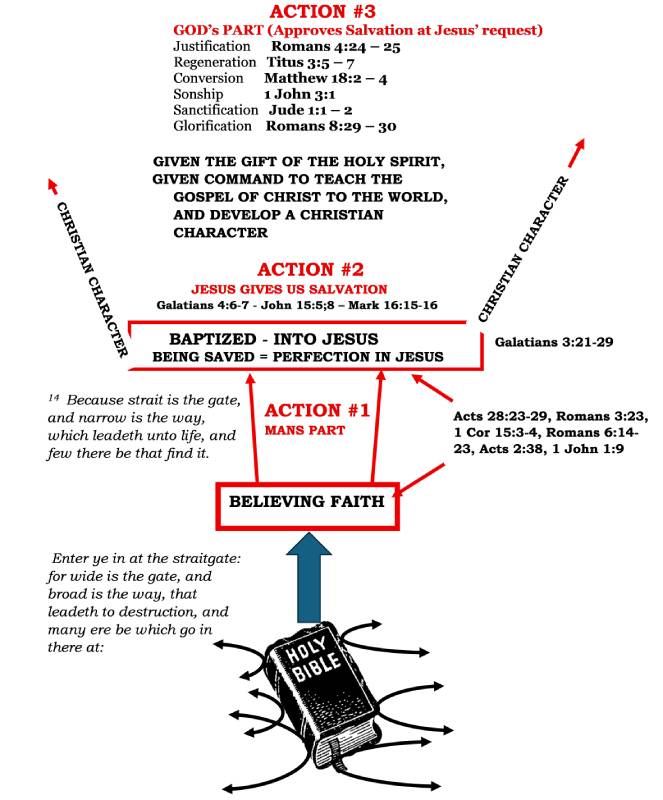
In a world full of shifting ideologies and false doctrines, believers must hold fast to the truth of the gospel. Understanding the Biblical foundation for salvation equips us to stand firm in our faith and share the hope of eternal life with others. Let us treasure this gift and live each day in light of its glory. Here is a chart showing the process of salvation.