
OUTLINE OF UNDERSTANDING THE DOCTRINE OF CHRIST,
According to Hebrews 5:12-14 & 6:1-20
Ken Miller Author and Speaker
The book is a study guide by Ken Miller focused on understanding the Doctrine of Christ and developing a strong Christian character to achieve spiritual maturity and perfection in Christ, as well as, giving us the assurance that if we stay in God’s Grace on our own freewill, we will know that we are saved.
The following is a summary (generated by AI) of my book. I have added several charts at the end to help in seeing the “big picture” of God’s Word pertaining to what happens during the process of becoming a Christian up to and including maintaining our salvation till our physical death.
Understanding the Doctrine of Christ
This text explores the significance of the Doctrine of Christ and its implications for Christian character and spiritual maturity.
- The Doctrine of Christ is distinct from the Gospel of Christ, focusing on deeper teachings and principles.
- Many Christians today are considered “babes in Christ,” lacking maturity in their understanding of scripture.
- The author emphasizes the importance of growing in faith and understanding to avoid jeopardizing salvation.
- Key scriptures from Hebrews and Timothy highlight the necessity of spiritual growth and the dangers of remaining immature in faith.
- We will be creating a “big picture” of what God expects us to do in laying a foundation for perfection in Christ by building a strong Christian character that will overcome indoctrination.
What we see/hear/touch/taste/and smell (our five senses)
goes into our mind, which demands a thought.
Every thought demands an action.
Every repeated action creates a habit.
Every habit builds our character.
Jesus will judge every character.
The Importance of Spiritual Maturity
This section discusses the necessity of developing a strong Christian character to achieve perfection in Christ.
- Spiritual maturity is essential for overcoming indoctrination and living a life aligned with God’s teachings.
- The author stresses that thoughts lead to actions, which form habits and ultimately shape character.
- Jesus will judge every individual’s character based on their spiritual growth and adherence to scripture.
- The text encourages readers to engage deeply with the Bible and seek understanding through prayer and study.
The Role of Scripture in Christian Life
This part emphasizes the significance of scripture as the foundation for Christian doctrine and practice.
- All scripture is inspired by God and serves multiple purposes, including doctrine, reproof, and instruction in righteousness.
- The author warns against twisting scripture to fit personal beliefs, advocating for a literal interpretation of God’s Word.
- Understanding the original languages of the Bible (Hebrew and Greek) is crucial for grasping the intended meanings.
- The text encourages a disciplined approach to studying the Bible, using concordances and topical studies for deeper insights.
Key Doctrinal Points from Hebrews
This section outlines six major doctrinal points derived from Hebrews 6:1-12.
- The Doctrine of Christ includes foundational principles such as repentance, faith, baptism, and eternal judgment.
- It is possible to lose one’s salvation if one falls away after experiencing enlightenment and partaking in the Holy Spirit.
- Christians are called to live in perfection, producing good works and avoiding spiritual stagnation.
- Maintaining faith and service to God until death is essential for salvation and eternal life.
- God judges the thoughts and intents of the heart, emphasizing the importance of inner spiritual integrity.
The Challenge of Unlearning Misconceptions
This part addresses the difficulties of overcoming ingrained beliefs and societal norms that distort biblical teachings.
- Many individuals struggle to unlearn decades of denominational indoctrination that conflicts with scripture.
- The text highlights the need for personal accountability in understanding and applying God’s Word.
- The author encourages readers to confront societal liberal viewpoints that may lead to a distorted understanding of Christianity.
- A commitment to serving God over societal norms is essential for true spiritual growth and understanding.
Practical Approaches to Studying the Bible
This section provides guidance on effective methods for studying scripture to gain a comprehensive understanding.
- The author advocates for a structured approach to Bible study, emphasizing the importance of context and thematic organization.
- Utilizing concordances and topical studies can help readers stay focused and avoid misinterpretation.
- The text encourages prayerful preparation and a genuine desire to understand God’s Word as a means of spiritual growth.
- The author shares personal experiences and insights gained from studying the original languages of scripture, underscoring the value of deep engagement with the text.
Importance of Bible Study and Translation
Understanding the significance of studying the Bible and choosing the right translation is crucial for spiritual growth.
- The original Greek text of the New Testament is considered more authoritative than any translation.
- Translations should convey the meaning of the original text to readers effectively.
- The King James Version (KJV) and New King James Version (NKJV) are recommended alongside other versions for reference.
- All scripture is inspired by God and is beneficial for teaching and correction (2 Timothy 3:16).
The Role of Community in Faith
Assembling with like-minded believers is essential for spiritual growth and understanding.
- Christians are encouraged to gather and support one another in faith (Hebrews 10:25).
- The Church is not just a building but the collective body of Christ (1 Corinthians 12:27).
- Good study habits and a conducive environment enhance learning about God’s Word.
The Need for Consistent Study Habits
Setting aside dedicated time for Bible study is vital for spiritual development.
- Establish a specific daily time for study and communicate this to family and friends.
- Create a distraction-free environment to focus on learning.
- James 4:7–8 emphasizes the importance of submitting to God and resisting distractions.
Setting Goals for Spiritual Growth
Establishing clear, achievable goals can enhance one’s Bible study experience.
- Goals should be specific, realistic, and time-bound.
- Regularly review and adjust goals as needed to align with spiritual growth.
Understanding Sin and Its Consequences
Sin is a fundamental issue that separates humanity from God, originating from the disobedience of Adam and Eve.
- All humans are born into sin (Romans 3:23).
- Sin leads to spiritual death and separation from God.
- The battle between sin and the Holy Spirit occurs within individuals (Romans 7:14–20).
The Importance of Accurate Bible Translation
Differentiating between translation and interpretation is crucial for understanding scripture accurately.
- Many modern translations may distort the original meaning of the text.
- The KJV is considered the closest true translation, while many contemporary versions are criticized for inaccuracies.
- A good concordance and an open heart are essential for effective Bible study.
Identifying the Correct Church
The true Church is defined by adherence to scripture and the teachings of Christ.
- The Church is a spiritual body of believers, not a physical building.
- Denominationalism can lead to confusion and misinterpretation of scripture.
- The Bible outlines the structure and function of the Church (Ephesians 4:1–16).
The Dangers of Denominationalism
Denominational teachings can lead to varying interpretations of scripture and salvation.
- Many denominations have their own requirements for salvation, often deviating from biblical teachings.
- The term “denomination” implies a modification of God’s Word to fit human beliefs.
- Revelation 22:18–19 warns against adding or taking away from scripture.
The Concept of Faith-Only Salvation
Faith-only beliefs can misrepresent the complete plan of salvation as outlined in scripture.
- Many faith-only groups ignore the necessity of baptism in the salvation process.
- Key verses are often quoted out of context to support these beliefs.
- True faith involves obedience to God’s commands, including baptism (Mark 16:15–16).
Understanding the Nature of the Trinity
The text discusses the relationship and hierarchy among the Father, Son, and Holy Spirit within the concept of the Trinity.
- God the Father, God the Son, and God the Holy Spirit are distinct persons but are unified in essence.
- The author argues against the notion of Jesus and the Holy Spirit being equal to God the Father.
- Jesus is described as having dominion over spiritual matters and is referred to as the “tree of life.”
- The Holy Spirit is responsible for guiding believers and interceding on their behalf.
The Role of Baptism and the Lord’s Supper
This section critiques the interpretation of baptism and the Lord’s Supper as prerequisites for church membership rather than for salvation.
- The author emphasizes that baptism should be understood as being into Jesus Christ, not merely into a local church.
- Romans 6:3-5 is cited to support the view that baptism signifies a believer’s identification with Christ’s death and resurrection.
- The text warns against altering the biblical meaning of baptism, referencing Revelation 22:19.
Critique of Rigid Traditional Beliefs
The text critiques various Christian denominations for adhering to rigid traditions that may conflict with biblical teachings.
- The author identifies groups such as Catholics, Presbyterians, and Lutherans as examples of rigid traditionalism.
- These groups are said to impose church laws and traditions that may not align with the original teachings of the first-century church.
- The text argues for a return to the practices of the early church as outlined in the Bible.
Structure of a Biblical Church
This section outlines the essential characteristics of a biblical church based on New Testament teachings.
- A biblical church is led by qualified elders and deacons, with no hierarchical structure among elders.
- It emphasizes the importance of gathering in Jesus’ name, celebrating the Lord’s Supper, and maintaining group holiness.
- The church is a place for believers to use their spiritual gifts to serve one another.
The Definition of “Testament” in Scripture
The text clarifies the biblical definition of “testament” and when the New Testament began.
- The New Testament is said to have begun with Jesus’ ascension into heaven, not with the Gospels.
- The author argues that the Gospels detail the last years of the Old Testament period and the establishment of the New Testament.
- Hebrews 9:11-17 is cited to support this claim.
The Great Commission Explained
This section elaborates on the Great Commission as Jesus’ final instructions to His disciples.
- The Great Commission encompasses the call to preach the Gospel and baptize believers.
- The author emphasizes the importance of understanding all accounts of the Great Commission in Matthew, Mark, and Luke.
- The text argues that the Great Commission is critical to God’s plan for salvation.
The Doctrine of Christ Defined
The text outlines the doctrine of Christ and its significance in Christianity.
- The doctrine of Christ is described as the heart and soul of Christianity, distinct from the Gospel of Christ.
- Six specific components of the doctrine of Christ are identified, including repentance, faith, and baptism.
- The author stresses the importance of adhering to this doctrine for salvation.
The Importance of Repentance
This section discusses the necessity of repentance in the Christian faith.
- Repentance is defined as turning away from sin and is essential for maintaining a relationship with God.
- The text cites biblical examples of God’s expectation for repentance and the consequences of failing to repent.
- The author emphasizes that true repentance leads to restoration and fellowship with God.
The Role of Faith in Salvation
The text highlights the critical role of faith in the process of salvation.
- Believing faith is presented as foundational for salvation, as outlined in Romans 1:16-17.
- The author argues that faith must be accompanied by trust in God and obedience to His will.
- The text concludes that faith is essential for developing Christian character and maintaining salvation.
Understanding the Doctrine of Baptisms
This section explains the different types of baptism mentioned in the Bible.
- Three types of baptism are identified: John’s baptism, Christian baptism, and baptism of the Holy Spirit.
- The author clarifies that only Christian baptism is part of God’s plan for salvation.
- The text emphasizes the importance of understanding the original Greek meaning of baptism, which means to submerge, not sprinkle.
Importance of Christian Baptism
Christian baptism is essential for salvation and receiving the Holy Spirit.
- Two actions are required for salvation: belief and baptism (Mark 16:16).
- Baptism symbolizes being buried with Christ and rising to a new life (Romans 6:3-9).
- Paul was instructed to be baptized to wash away his sins (Acts 22:12-16).
- Repentance and baptism are interconnected, as shown in Acts 2:37-41.
Understanding the Doctrine of Christ
The doctrine of Christ encompasses key elements of faith, baptism, and the Holy Spirit.
- Believers are baptized into Christ and receive the Holy Spirit (Galatians 3:26-27).
- There is one Lord, one faith, and one baptism (Ephesians 4:2-5).
- The Holy Spirit guides believers into all truth (John 16:7-15).
Spiritual Gifts and Unity in the Church
Each Christian receives specific spiritual gifts, promoting unity within the body of Christ.
- Spiritual gifts are diverse but come from the same Spirit (1 Corinthians 12:1-31).
- The body of Christ consists of many members, each with unique roles (1 Corinthians 12:12-27).
- Love is the greatest virtue that should accompany the use of spiritual gifts (1 Corinthians 13:1-13).
The Role of Laying on of Hands
Laying on of hands is a significant practice in the early church for various purposes.
- It was used for ordination, prayer for healing, and passing on spiritual gifts (Acts 19:1-7).
- The practice ceased after the apostles’ death, as the Bible became the complete revelation (1 Corinthians 13:1-13).
Resurrection of the Dead
The resurrection of the dead is a fundamental belief in Christianity, with two key events.
- The first resurrection occurred when Jesus died, and many saints arose (Matthew 27:50-54).
- The final resurrection will happen at Jesus’s second coming, with no one knowing the exact time (Mark 13:31-33).
Eternal Judgment and Accountability
Eternal judgment emphasizes the necessity of living according to God’s will for salvation.
- Not everyone who claims to know Jesus will enter heaven (Matthew 7:21-23).
- Individuals will be judged by their words and actions (Matthew 12:36-37).
- The names of the saved are recorded in the book of life (Revelation 20:11-15).
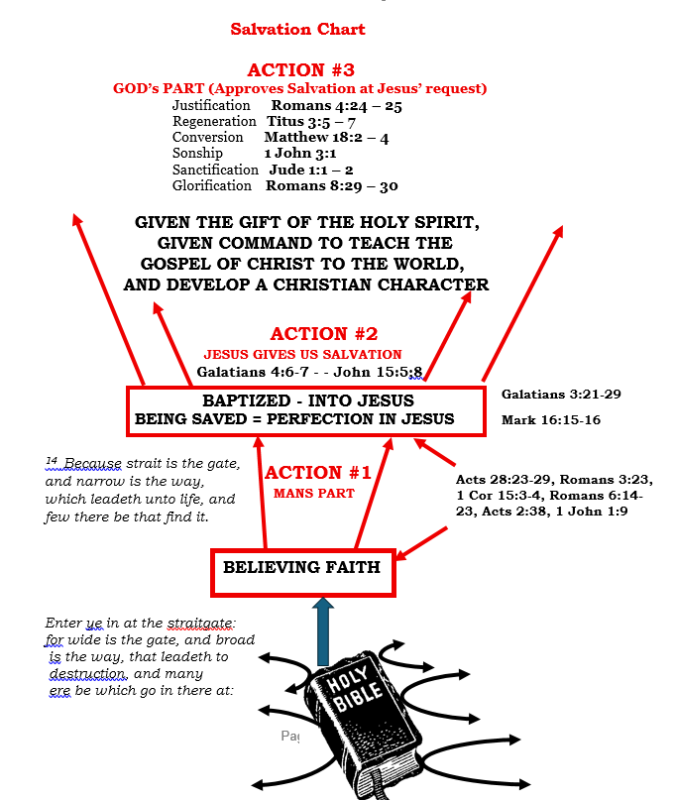
Overview of God’s Plan for Salvation
God’s plan for salvation involves a combination of actions from humans, Jesus, and God.
- Humans must hear, believe, confess, repent, and be baptized (Mark 16:16).
- Jesus provides salvation through His sacrifice and the Holy Spirit (Romans 6:1-6).
- God approves salvation through justification, regeneration, and sanctification (Titus 3:5-7).
The Importance of Repentance and Baptism
Repentance and baptism are essential steps in the process of salvation, leading to the remission of sins and the gift of the Holy Spirit.
- Repentance is a prerequisite for baptism.
- Baptism is performed in the name of Jesus Christ for the remission of sins.
- Receiving the Holy Spirit provides comfort, guidance, and purpose.
- Belief and baptism are necessary for salvation, while disbelief leads to condemnation.
Understanding Salvation Through Jesus
Salvation is a supernatural act of God that requires human faith and action, particularly through baptism.
- Jesus’s actions in salvation are beyond human control.
- After baptism, believers are expected to maintain their faith and good works.
- The Holy Spirit dwells within believers, empowering them to live a Christian life.
- Christians are called to produce good fruit as evidence of their faith.
The Process of Maintaining Salvation
Maintaining salvation involves a continuous effort to develop a Christian character and live according to God’s commandments.
- Believers are expected to strive for perfection in their Christian character.
- Daily repentance and a personal relationship with Jesus are crucial for spiritual growth.
- Good works are a command from Jesus, reflecting one’s faith and commitment.
- The process of character development includes patience, experience, and hope.
The Role of Scripture in Christian Life
Scripture serves as a guide for doctrine, correction, and instruction, helping believers to achieve perfection in Christ.
- All scripture is inspired by God and profitable for teaching.
- Believers are encouraged to study the Word to grow in faith and understanding.
- The Word of God discerns the thoughts and intents of the heart.
- Regular engagement with scripture is essential for spiritual maturity.
The Consequences of Losing Salvation
Christians can lose their salvation if they turn away from God and fail to maintain their faith and good works.
- Hebrews 6:4–6 warns against falling away after experiencing God’s grace.
- The concept of “once saved, always saved” is challenged by scripture indicating the possibility of losing salvation.
- Believers are responsible for their spiritual state and must heed God’s warnings.
- The importance of living a Christian life is emphasized to avoid eternal separation from God.
The Call to Develop Christian Character
Developing a Christian character is a lifelong process that requires intentional effort and reliance on the Holy Spirit.
- Character is shaped by choices and influences throughout life.
- The fruit of the Spirit is essential for building a godly character.
- Believers must actively work to change their character to align with Christian values.
- The journey of character development involves continuous learning and growth in faith.
God’s Promises and Encouragement to Joshua
This section emphasizes God’s assurance to Joshua regarding his leadership and the importance of strength and courage in fulfilling his mission.
- God promises Joshua the land from Lebanon to the Euphrates and the Great Sea as his territory.
- God assures Joshua that no one will stand against him, just as He was with Moses.
- Joshua is encouraged to be strong and courageous, as he will divide the land among the people.
- The importance of adhering to the law given by Moses is highlighted for prosperity and success.
- God reiterates His presence with Joshua, urging him not to be afraid or dismayed.
Characteristics of a Christian
This section outlines the attributes that define a mature Christian character, focusing on the fruits of the Spirit.
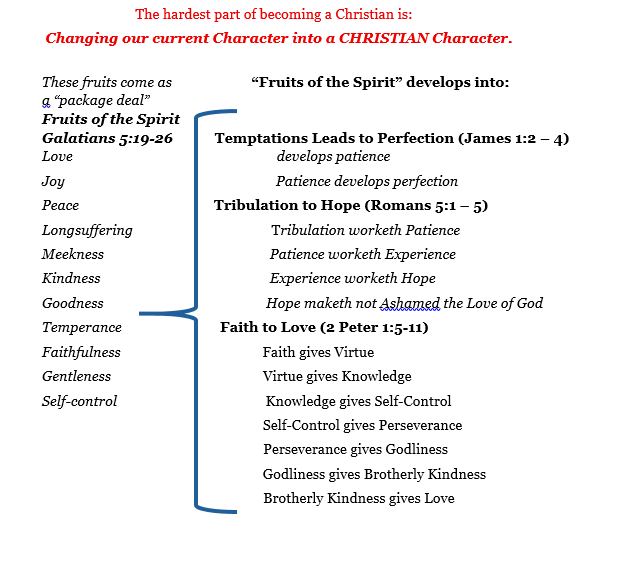
- The fruit of the Spirit includes love, joy, peace, patience, kindness, goodness, faithfulness, gentleness, and self-control.
- Christians are encouraged to live and walk in the Spirit, avoiding conceit and envy.
- Maturity in faith is a choice, leading to the development of Christian character.
- The growth pattern includes patience leading to perfection, tribulation leading to hope, and faith leading to love.
The Role of Parents in Character Development
This section discusses the influence of parental guidance on character formation and the responsibility of parents.
- Character is shaped from birth through parental training and guidance.
- Parents are held accountable for their children’s character development.
- The “age of accountability” marks the transition to personal responsibility for one’s actions.
- A loving Christian upbringing is ideal for establishing a strong character.
Five Cornerstones for Building Character
This section presents five foundational principles for developing a character that aligns with Christian values.
- The gift of choice is emphasized as crucial in shaping one’s character.
- Acknowledges the struggle with sin and the importance of focusing on God for character transformation.
- The author shares personal experiences of change and commitment to God’s guidance.
The Importance of Thoughts in Christian Life
This section highlights the significance of thoughts in shaping actions and character.
- Thoughts are influenced by sensory experiences and lead to actions.
- The necessity of keeping God at the center of thoughts and actions is emphasized.
- The relationship between character and daily actions is explored.
Actions Reflecting Christian Character
This section discusses how daily actions should align with Christian values and the importance of resisting the Holy Spirit.
- Every action is a reflection of one’s character and relationship with God.
- The need for Christ-centered actions is stressed to avoid sin.
- The importance of humility and sincerity in actions is highlighted.
Developing Good Habits in Faith
This section focuses on the formation of habits through repeated actions and their impact on character.
- Good and bad habits are formed through repeated actions.
- The necessity of evaluating and changing habits to align with God’s will is discussed.
- The author shares personal struggles with habits and the importance of divine guidance.
The Role of the Holy Spirit in Character Formation
This section emphasizes the Holy Spirit’s role in guiding and transforming character.
- The Holy Spirit convicts and guides individuals towards righteousness.
- The importance of surrendering to the Holy Spirit for character change is highlighted.
- Personal testimonies illustrate the transformative power of the Holy Spirit.
Conclusion on Character and Faith
This section concludes with a reflection on the importance of character in relation to faith and eternal destiny.
- Character is a daily reflection of one’s relationship with God.
- The choice to align character with God’s will is emphasized as crucial for salvation.
- The text encourages self-reflection on whether one’s character demonstrates a life controlled by God.
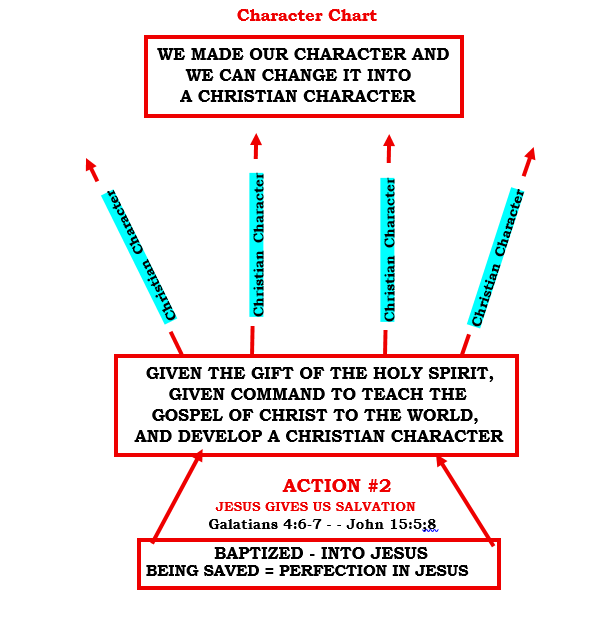
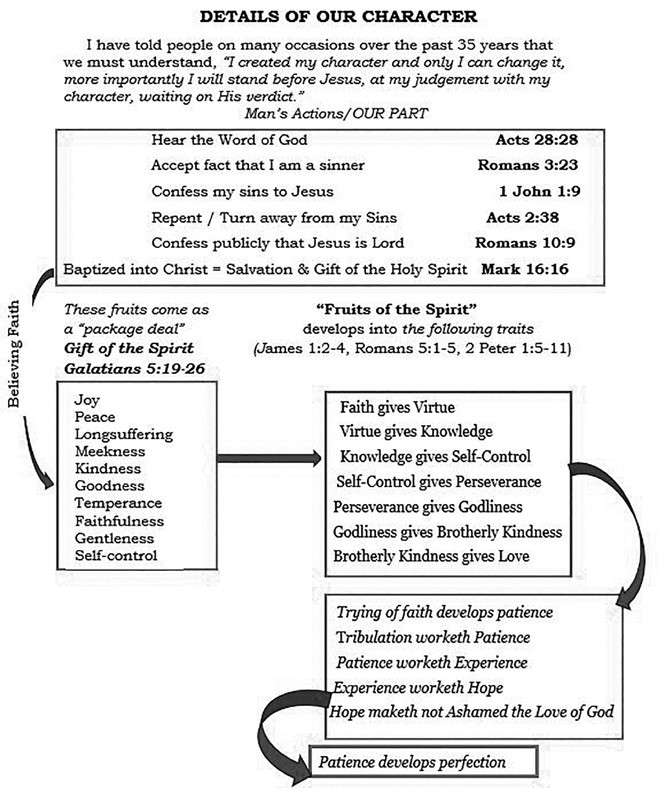
I have told people on many occasions over the past 35 years that we must understand that, “I created my character and only I can change it, more importantly I will stand before Jesus, at my judgement with my character, waiting on His verdict.”
Teaching gives knowledge
Knowledge gives desire
Desire gives training
Training produces experience
Experience builds confidence
Confidence builds consistency
Consistency establishes Maturity (Perfection)
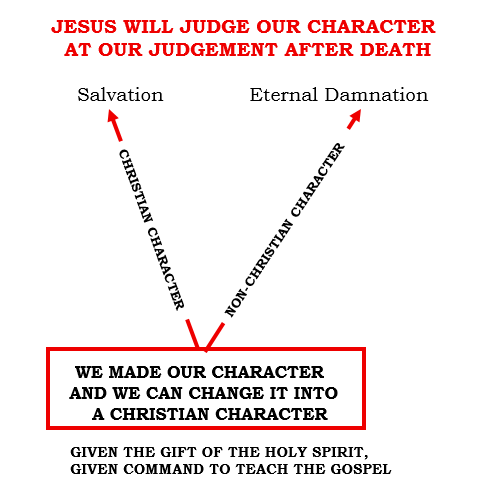
A CHRISTIAN CHARACTER GIVEN THE GIFT OF THE HOLY SPIRIT, GIVEN COMMAND TO TEACH THE GOSPEL OF CHRIST TO THE WORLD AND DEVELOP OUR CHRISTIAN CHARACTER

What we see/hear/touch/taste/and smell (our 5 senses)
Goes into our mind, which demands a thought,
Every thought demands an action,
Every repeated action creates a habit,
Every habit builds our character,
Jesus will judge every character.